
Most product budgets are not lost during development, they are lost before it, when a team builds something nobody asked for.
Product discovery exists to prevent that: reducing the risk of building the wrong thing before it costs months of engineering. This post covers how to map the problem space, which validation techniques work before the build, and how to know when discovery is done.
Why most products fail before a line of code is written
42% of startups fail due to no market need, the top cause identified in CB Insights' analysis of startup post-mortems, and the problem is rarely technical.
Teams pick frameworks, argue architecture, stand up CI/CD, and only later discover the user wanted something else. That late discovery can multiply the original budget by three or four, because rewriting deployed functionality is work nobody budgeted for.
We treat discovery as a service in its own right through product discovery, not a UX formality, because a checklist of wireframes before sprints start throws away the chance to invalidate cheap assumptions.
- Teams interview users only to confirm what they already decided, closing off the chance to find contrary evidence.
- Founders scope the product from intuition instead of evidence, producing a backlog disconnected from real needs.
- Stakeholders confuse alignment with having attended a kickoff meeting, without reaching real shared understanding.
How to map the problem space without building anything
The starting point is understanding the job your user is trying to get done, and Jobs to Be Done works better here than traditional surveys.
A JTBD interview does not ask "what features do you want," it asks "tell me about the last time you tried to solve this and what happened." That difference exposes the real friction in the user's current flow.
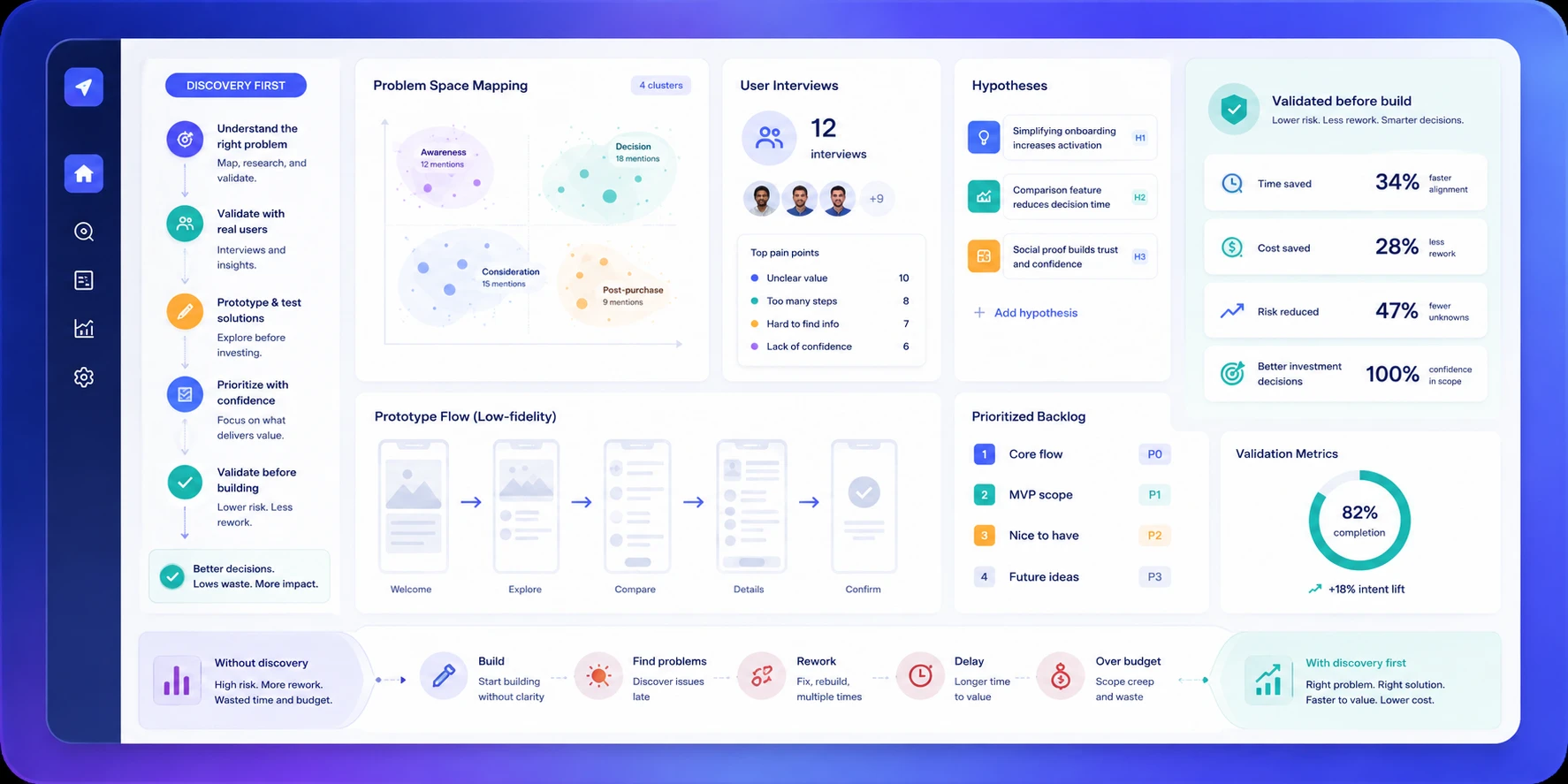
You need 12 to 20 interviews to reach saturation in a segment. Record each session with consent, transcribe with tools like Otter.ai, and cluster the findings into pain points.
Each cluster becomes a job statement anchored in observed behavior: "When [situation], I want [motivation], so I can [expected outcome]." Those statements feed personas grounded in behavior, not invented demographics.
Each finding becomes a testable hypothesis with three parts: belief, metric, and acceptance criteria.
For example: "we believe an instant-payment solution reduces payment management time to under 10 minutes daily, measured in the first week of use." That gives a clear target for testing any prototype.
Which validation techniques work before the build
Untested hypotheses are just opinions with formatting. The goal is testing each assumption with the least effort possible, raising fidelity only when evidence justifies it.
Start with low-fidelity prototypes in Figma. A clickable flow of 5 to 8 screens tests the core value proposition with real users in 30-minute sessions. If 60% of participants cannot complete the main flow, the problem is conceptual, and no visual design will fix it.
Once the low-fidelity prototype validates the direction, the next step is an instrumented MVP.
A Flutter MVP with Firebase Analytics and Crashlytics fits that role; if the backend needs business logic, a Nest.js service instrumented over AWS CloudWatch captures latency, errors, and usage patterns.
This is the same stack we use in full product development, and staff augmentation covers any capacity gap without stretching the timeline.
A/B tests come in once you have enough traffic for statistical significance, typically 2 to 4 weeks for an early MVP with 200 active users to produce results at 95% confidence.
- In CAA Club Group (Canada's largest automobile association, 7M+ members), discovery defined the roadside assistance flow before a line of code was written.
- In ProWallet, an instant-payments fintech, early validation with contractors in Texas narrowed the MVP to three features that actually moved the needle, dropping eight the interviews never surfaced.
- In MyBotPal for Huawei, discovery defined the multi-language architecture before the team touched Kotlin or Swift for the native modules.
When to close discovery and move to the build
Discovery without a closing criterion turns into analysis paralysis. The signals that say you are ready to build are both quantitative and qualitative, the kind of judgment call we get into on The CTO Lounge.
- Interview saturation: the last 3 to 4 sessions surface no new jobs, meaning the segment is well understood.
- Prototype completion rate above 80% on the main flow, confirming the value proposition is navigable.
- At least one business metric validated with real data, whether purchase intent, time saved, or projected usage frequency.
When stakeholders can describe the product in one sentence without contradicting each other, that is real alignment. When engineering can estimate the backlog with under 30% variance between individual estimates, scope is defined enough.
A well-closed discovery produces a document that turns ambiguity into estimable scope, with validated user flows, preliminary architecture, a prioritized backlog, and an investment range for the build, the same input that defines how the team gets staffed to build the product.
Frequently asked questions
How long does a well-run discovery sprint take?
A full discovery sprint takes 2 to 4 weeks, depending on the problem's complexity and user availability for interviews. That range covers JTBD research, hypothesis definition with metrics, and prototype validation.
How many users do you need to test a prototype with?
For low-fidelity prototype sessions, 5 to 8 participants per segment usually reveal the most critical usability issues. If 60% or more cannot complete the main flow, the concept needs revision before scaling further.
Does discovery apply the same way to B2B and B2C products?
The JTBD framework and testable-hypothesis logic apply to both, though in B2B the stakeholder map is more complex because the user operating the product rarely matches the buyer. That distinction needs to be clear before designing interviews.
What if discovery results contradict the original product vision?
That contradiction is precisely the value of the process. Finding out the original vision does not match real needs during discovery costs a fraction of what it would cost after months of development.
Can a founder run discovery alone, or is a dedicated team necessary?
A founder can lead interviews and build early prototypes, but interpreting findings benefits from at least two perspectives to reduce confirmation bias. When the product carries high technical complexity, involving an engineer from discovery onward keeps user flows grounded in what is actually feasible.
Skipping discovery does not save time, it just moves the cost to a later, more expensive point in the project, that is what the ProWallet and MyBotPal timelines show when you compare the scope they shipped against the scope they started with.
If you're searching for a trusted software development partner, look no further. Contact us today to learn how we can help you turn your vision into reality with our tailored, high-quality solutions.