
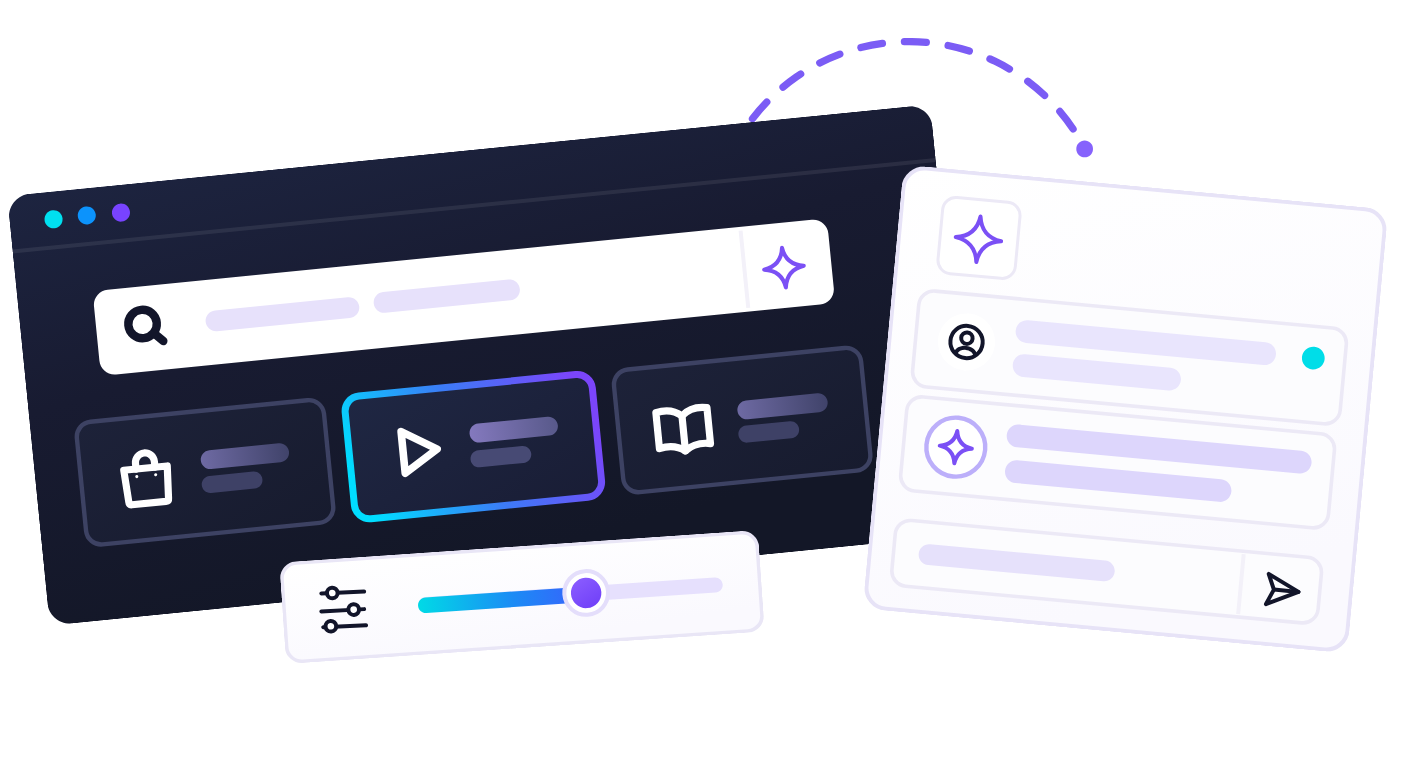
AI use cases we build into products
Eight features we add to apps that already exist. Each one tied to something your customers do today.
AI search
Understands natural language, synonyms, and misspellings, so a query returns results even when the words do not match your database.
Recommendations
Suggests the next product, article, or action from behavior, catalog, and context.
In-app AI assistant
Answers questions from the customer's own account and history, and completes actions inside the product.
Personalization
Adapts content, defaults, ordering, and onboarding to each person.
Document and image processing
Extracts, classifies, and validates data from what customers upload or photograph, so forms complete themselves.
Predictive features
Scores risk, forecasts demand, and detects anomalies, surfaced in time to act on.
AI-generated content
Produces drafts, summaries, and descriptions for a person to review and approve.
Voice and conversational interfaces
Speech and dialogue where typing is impractical.
The AI we recommend is AI we operate
An AI-native product agency
We build the AI feature and the product around it, with one team.
The AI layer gets built once.
On cross-platform products the feature ships across mobile, web, and desktop from a single codebase. Building with Flutter since 2018.

Talk to us about your product
Tell us what your customers do in it and where they get stuck. We will tell you which AI features would change that.


Ready to Start Your Journey?

I would love to talk to you about your project or needs.
Fill in the form or send us an email to hello@somniosoftware.com
Got an idea? We’ve got the skills.
Fill out our contact form and we’ll get in touch!
Schedule a call
Feel free to select a time at your convenience!
Questions worth asking
Still have some doubts?
No worries, here are some frequently asked questions that may help you.
We start from what your customers already do in the product and where they get stuck, then add the AI feature at that point: search, recommendations, an assistant, document processing. The same team builds the feature and the product work around it, including the interface, the release process and the support path, so it ships as part of your app rather than as a separate tool.
The ones tied to something customers already do. Search that understands intent, recommendations, forms that complete themselves from an uploaded document, and assistants that answer from the customer's own account tend to pay off, because they remove friction at an existing step instead of adding something new to learn.
Yes. These are features we add to apps that already exist, so the work includes integrating with your current backend, data and release process. On cross-platform products the AI layer is built once and ships across mobile, web and desktop from a single codebase.
By grounding it in your own data and limiting what it can do. Assistants answer from the customer's account and history rather than from general knowledge, generated content goes to a person to review and approve, and the feature is tested against real cases before release and measured after it.
It depends on usage, since every AI request has a cost. We estimate the cost to build and to run before starting, and keep it under control in production by choosing the right model for each task and caching what repeats. You see the expected running cost before you approve the work.
Yes. Mobile is where most of our work is. We have been building with Flutter since 2018, and on cross-platform products the AI feature ships across mobile, web and desktop from a single codebase.
It depends on the feature and on the state of your data. We scope a first feature narrowly so it can reach users early and be measured, and you get a clear timeline before anything is built.