
Picking the wrong technical partner for a healthcare app can cost far more than the project budget. HIPAA violation fines reach up to $2.19M per violation category, and a clinical data breach destroys patient trust that took years to build.
Most healthcare organizations discover these gaps after signing, when the team they hired improvises compliance instead of designing it into the architecture from the start.
Healthcare partner vs. generic software shop
The difference shows up in the first sprint, not the last. A partner with real healthcare experience treats security as an early architectural decision, where encryption, access control, and audit logs get defined before the first line of business code.
If your candidate talks about HIPAA as a checklist added right before launch, that is a red flag.
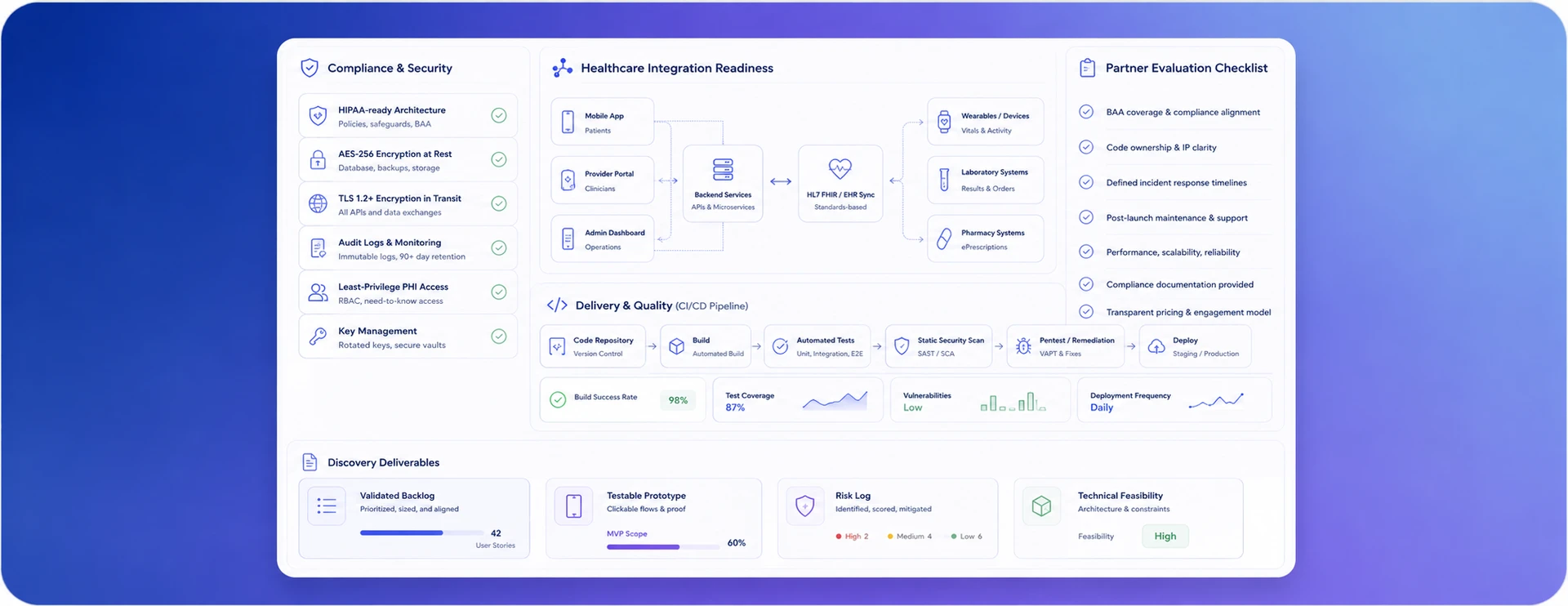
Evaluating HIPAA-compliant app development experience means going past the obvious question. Ask how they structure a Business Associate Agreement and how they implement least-privilege access to PHI.
A team that actually worked under healthcare regulation will have specific answers referencing real projects, not generic definitions.
Connecting to systems like Epic, Cerner, or Allscripts through HL7 FHIR is another filter that separates real experience from marketing. A partner with a track record should show an integration map from a previous project.
- HIPAA described as a checklist added right before launch, not designed into the architecture from the start.
- Generic answers about Business Associate Agreements, with no reference to real projects.
- No explanation of least-privilege access to PHI or data retention practices.
- No integration map from a past project showing EHR sync strategy.
How to read a healthcare portfolio without getting fooled
The most common trap is stopping at logos. An agency listing "healthcare" as an industry served says nothing about depth of work. What you need are real adoption metrics and evidence they solved problems similar to yours.
Look for cases with verifiable user or transaction numbers, hard to fake and proof a product survived contact with real users.
At Somnio our verifiable cases range from ProWallet in fintech to CAA with 7M+ members in Canada.
In healthcare specifically, we built MakeVisible, a wearables app monitoring chronic patients through sensor data and phone-camera heart-rate measurement, the level of complexity you want in a healthcare portfolio, and the kind of product landscape we break down in our look at healthcare products in 2026.
Stack depth matters too. A serious healthcare project may need SSR web for patient portals, cross-platform apps for mobile, robust backends, and compliance-certified infrastructure.
Teams that pair Flutter with Next.js, Kotlin, Swift, Nest.js, Firebase, and AWS carry the versatility a healthcare project demands. A stack limited to one technology creates dangerous dependencies at scale.
Layer · Representative tech · Used for in healthcare
Web frontend · Next.js (SSR) · Patient and provider portals with fast load and controlled SEO
Mobile apps · Flutter, Kotlin, Swift · Patient touchpoint, wearable and sensor integration
Backend · Nest.js, Node.js · Clinical data processing and EHR integrations
Infrastructure · AWS, Firebase · Compliance-certified storage and scalability
Key questions before you sign
Before committing budget, there is a set of artifacts you should require. Each one reveals whether the team has real operational experience or is improvising.
Ask for pentest results from previous projects, with evidence of how findings were remediated.
A team that never ran a pentest on a healthcare project likely never worked under real regulation. Ask to see their CI/CD pipeline and their encryption policy, both in transit (TLS 1.2+) and at rest (AES-256 or equivalent).
For patient-engagement integrations, Apple Health and Google Fit connections, pharmacy integrations, and bidirectional EHR sync are the ones that most affect adoption.
On the contractual side, confirm the Business Associate Agreement is covered, with clear clauses on code ownership and incident notification timelines.
- Pentest results from previous projects, with documented remediation evidence.
- A CI/CD pipeline with quality gates and static security analysis.
- Explicit encryption policies in transit and at rest, plus key management.
- A Business Associate Agreement covering code ownership and incident timelines.
- A post-launch maintenance plan covering dependency and EHR API updates.
Why a discovery sprint reduces risk
Healthcare app timelines range from 4 months for a telemedicine MVP to 12+ months for a platform with full EHR integrations and FDA certification. That variability makes committing a large budget without prior validation an unnecessary bet.
A 2-to-4-week discovery sprint produces three deliverables that change the conversation: a validated backlog prioritized by clinical value, a navigable prototype, and a risk log flagging the integrations and compliance requirements that will affect the timeline.
- A validated backlog prioritized by clinical value and technical feasibility.
- A navigable prototype testable with real users before production code.
- A risk log identifying complex integrations and compliance requirements.
With these artifacts in hand, moving to development stops being an act of faith, and the deliverables are yours to take anywhere if the discovery partner is not the one you build with.
For technically complex products, staff augmentation can plug in specialized profiles without a lengthy hiring process.
Frequently asked questions
How much can a HIPAA violation fine cost?
HIPAA violation fines reach up to $2.19M per violation category, not counting reputational damage or legal costs tied to a data breach.
What is a Business Associate Agreement and why is it mandatory?
It is the contract through which a vendor takes formal responsibility for handling Protected Health Information. Without it signed, the healthcare organization is legally exposed to any incident involving patient data.
What standard connects apps to electronic health records?
HL7 FHIR is the dominant standard, defining how clinical data is structured and transferred between systems like Epic, Cerner, or Allscripts. Implementing it well requires understanding each vendor's approval flow and API limitations.
Is a discovery sprint worth it before development?
A 2-to-4-week sprint produces a prioritized backlog, a testable prototype, and a risk log. Those deliverables are yours regardless of who you build with, making discovery an investment that reduces project uncertainty.
Which mobile integrations most affect patient adoption?
Apple Health and Google Fit connections, medication reminders, and bidirectional EHR sync most influence whether patients keep using the app. A partner with real experience can show how they solved at least one of these before.
The gap between a healthcare partner and a generic dev shop shows up in the questions they can answer before you sign, not the ones they promise to figure out later, and MakeVisible is the kind of project that only gets built by a team that had those answers ready.
If you're searching for a trusted software development partner, look no further. Contact us today to learn how we can help you turn your vision into reality with our tailored, high-quality solutions.