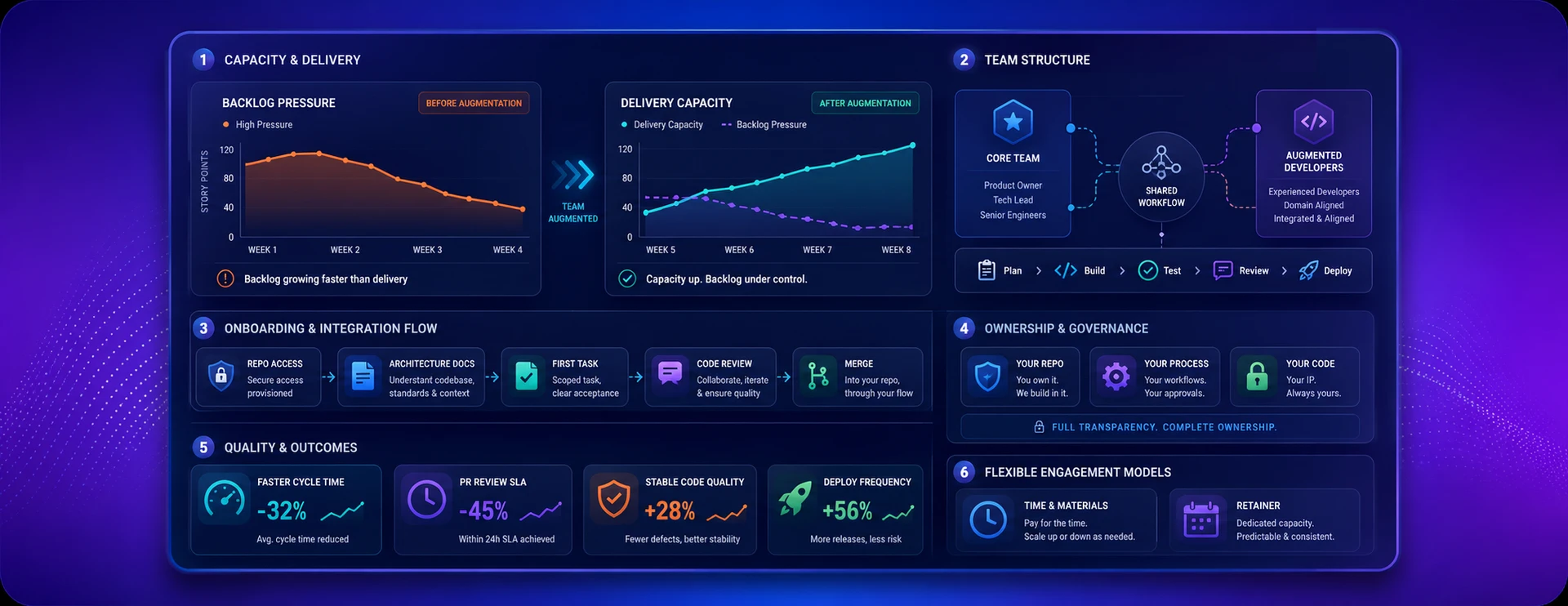

Every engineering org hits a point where the backlog grows faster than the team's capacity, and delivery pressure will not wait the 3-4 months it takes to hire, onboard, and stabilize a full-time developer.
Outsourcing the whole project solves capacity but creates another problem: you lose ownership over the code, the architecture decisions, and the technical debt you inherit later.
When augmentation fits and when it does not
Developer augmentation sits between full outsourcing and permanent hiring. An augmented developer works inside your repo, follows your conventions, joins your standups, and pushes to your branches.
The difference from outsourcing is operational, since product ownership never leaves your team. The difference from permanent hiring is contractual, since the commitment has a defined horizon.
- Demand spikes where you need 2-3 developers for 3 to 9 months for a big feature or a migration.
- Projects with a clear internal owner who needs more hands, but where the business context is already resolved.
- Product sprints where the bottleneck is execution capacity, not scope definition.
If what is missing is technical direction or product ownership, adding developers will not fix the problem, that gap usually needs product discovery before more headcount.
How to integrate augmented developers without breaking your flow
Most augmentation friction does not come from developer skill, it comes from a poorly planned integration.
A senior developer with solid experience produces mediocre output if they lack repo access on day one, do not understand the CI pipeline, or nobody explains why the payments module is structured the way it is.
Realistic ramp-up to stable output runs 2 to 6 weeks, depending on domain complexity and onboarding quality.
Compressing that toward 2 weeks needs a repeatable checklist: full repo and staging access from day one, an architecture document covering conventions, a list of commands to run the project locally, and a real sample task calibrated for 2-3 days that forces the developer to touch the full pipeline from branch to merge.
Pair programming during the first week accelerates context transfer in a way no document can match. The augmented developer sees how variables get named, where tests go, and which PRs get approved fast versus which generate discussion.
To keep code quality high, tooling matters more than trust. Set code ownership rules so every PR from an augmented developer requires review from someone on the core team.
Use trunk-based development with frequent merges to avoid long divergences. Define PR review SLAs: 4 hours max for a first review, 24 hours max for merge or rejection.
The CI pipeline needs to run linting, unit tests, and static analysis on every push, catching problems before they reach review.
What it costs and how you measure results
The two most common contract models are Time and Materials (T&M) and retainer. T&M works well when scope is variable and you need flexibility to scale hours per sprint, since cost tracks hours consumed rather than a fixed commitment.
Retainer works better with predictable volume, whether that is a single senior developer or a full squad with defined composition and seniority, priced as a fixed monthly fee scoped to the engagement.
At Somnio we work with both models depending on the team's context, and we quote each one based on the specific composition and timeline a project needs.
On time zones, nearshore teams in LATAM operating on EST/CST offer 6 to 8 hours of overlap with the US and Canada, enough for synchronous standups and PR reviews within a 4-hour SLA.
Overlap with Europe is more limited, 3 to 4 hours, demanding more discipline in asynchronous communication.
- Cycle time, measured from "in progress" to production. An augmented developer should sit within the core team's range after week 6.
- PR review turnaround, with the 4-hour SLA for first review as the baseline.
- Defect rate post-merge, indicating whether incoming code matches internal quality. If it sits more than 20% above the team average after 6 weeks, there is a vetting or onboarding problem to diagnose.
At Somnio we operate from Uruguay with a stack that includes Flutter, Next.js, Kotlin, Swift, Nest, Firebase, and AWS through staff augmentation, backed by the same remote culture recognized in our Great Place to Work certification.
We apply this model on projects like ProWallet (payments fintech for construction), CAA Club Group (7M+ members in Canada), and Tracer Golf (13,200+ downloads).
How to make vetting and onboarding repeatable
The most expensive mistake in augmentation is discovering at week 4 that the developer does not have the level you need. Vetting has to be technical and practical, with a structure you can repeat every time you bring someone on.
- A seed repo with the real project stack, where the candidate spins up the environment, runs existing tests, and adds a small feature.
- A set of CLI commands that have to work without help, which tells you something on its own.
- A code review of a PR prepared with intentional errors, evaluating technical judgment and written communication.
Onboarding has to be a documented process with a core-team buddy assigned who answers questions during the first two weeks, access to relevant Slack channels from day zero, and a task sequence that climbs in complexity, the same growth curve we write about in career paths in tech.
The signals that augmentation is working show up earlier than you'd expect. If the developer is reviewing other teammates' code by week 3, they understood the codebase. If cycle time converges with the core team before week 6, integration worked.
Frequently asked questions
How is developer augmentation different from hiring an outsourcing agency?
With augmentation, the developer works inside your team, repo, and processes, so product ownership stays in your organization. With outsourcing, those responsibilities get delegated to the provider, creating dependency and technical debt that is hard to recover.
How long does it take an augmented developer to become productive?
Ramp-up to stable output takes 2 to 6 weeks depending on domain complexity. With structured onboarding and a real sample task from day one, that time can compress toward 2 weeks.
What happens if the augmented developer does not meet the expected level?
A three-layer vetting process (seed repo, CLI commands, and a code review with intentional errors) significantly reduces that risk before starting. If post-merge defect rate is more than 20% above the team average after 6 weeks, diagnose whether the problem is vetting or onboarding.
Does the model work if the core team is in Europe and augmented developers are in LATAM?
Overlap with Europe runs 3 to 4 hours, limiting synchronous sessions. That scenario needs more discipline in asynchronous communication and well-defined PR review SLAs so cycle time does not inflate.
When does a retainer make more sense than Time and Materials?
Retainer works better when work volume is predictable and you want a fixed monthly cost. T&M fits when scope varies sprint to sprint and you need flexibility without contractual penalties.
Getting the SLAs, the onboarding checklist, and the vetting process right up front is what let ProWallet and Tracer Golf scale engineering capacity without losing ownership of the product.
At Somnio Software, we work closely with companies to design and build high-quality digital products using modern technologies and development best practices.
If you're looking for a trusted partner to bring structure, expertise, and innovation to your next software project, we'd love to connect. Contact us to learn how we can help turn your product vision into reality.