
.png)
2025 continued the trend of AI becoming a practical part of everyday software work, from prototyping and coding to testing and documentation. Flutter also kept maturing, with steady releases that improved performance, tooling, and platform integration. This recap summarizes the most relevant Flutter and Dart updates from the year, alongside a clear view of how developer-facing AI tools and models evolved, and what the community focused on.
Whether you build products, write code, or follow the ecosystem, this is a chronological wrap-up of how Flutter and AI developed in 2025. (Flutter’s team also highlighted that nearly 30% of new free iOS apps were built with Flutter)
1. Flutter & Dart in 2025: Eight releases and a new era
Flutter’s team kept a rapid release cadence in 2025, shipping four stable Flutter updates (and corresponding Dart updates) – 3.29, 3.32, 3.35, and 3.38 – each packed with improvements. The focus was on performance, modularity, and future-proofing the framework for an AI-infused world. Here are the biggest changes:
Unified threads for native performance (Q4)
Flutter delivered its most significant architectural leap to date in late 2025: the “Great Thread Merge”. This engine change unifies the UI and platform threads on mobile, allowing Dart code to run on the main native thread for the first time. In practical terms, Flutter apps can now call native APIs synchronously using FFI (no more async channel messages for each platform call). The result is lower latency and simpler native interop – “smoother widget interactions and simpler bridges when integrating platform features”. Plugin authors gained new powers (direct calls into Swift/Java), but also a reminder: heavy work should be offloaded to Isolates to avoid jank. As Flutter’s October release notes put it, this thread alignment means “synchronous native calls via FFI, and fewer footguns for plugin authors”. It’s a big step toward Flutter feeling native-first on every platform.
Generative UI: Flutter + LLMs = Dynamic interfaces (Q4)
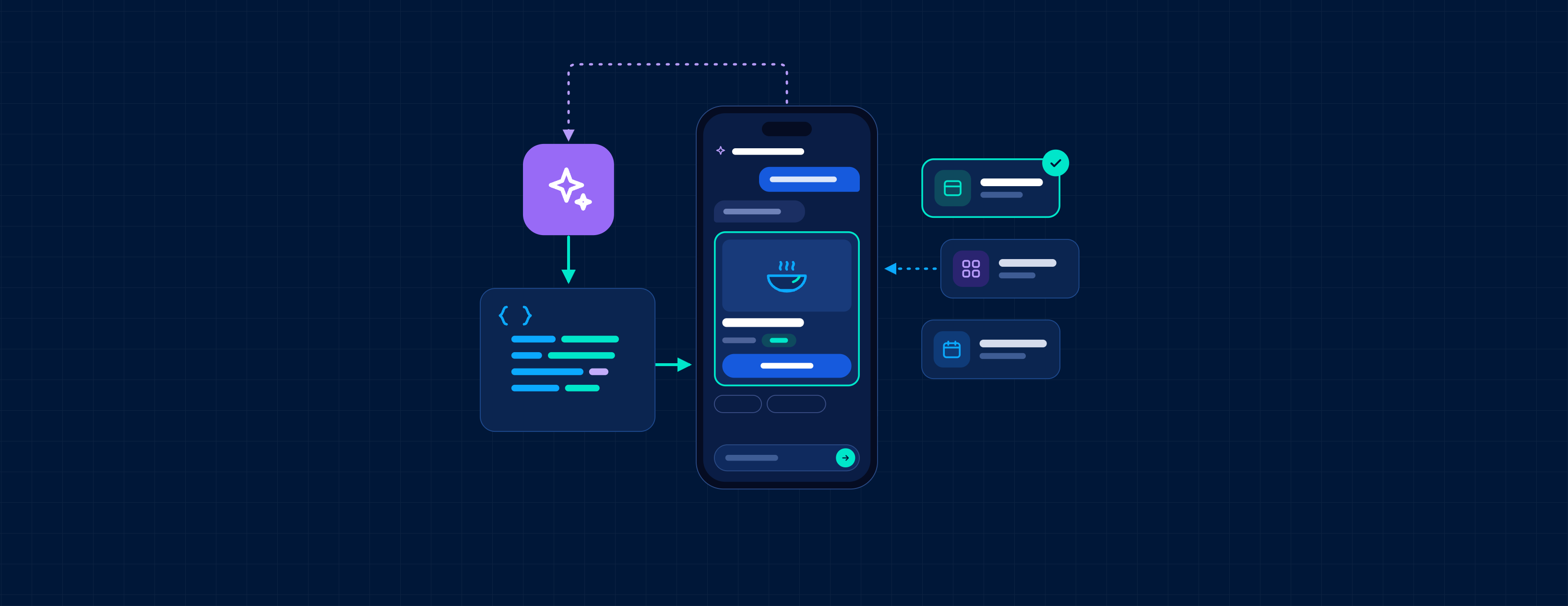
Another late-2025 milestone was the beta release of Flutter GenUI – an SDK that lets AI agents generate and orchestrate UI in real time. Instead of static, hard-coded screens, an LLM (like Google’s Gemini) can describe a UI in JSON and have your Flutter app render it on the fly. Under the hood, GenUI is built on Google’s new A2UI (Agent-to-UI) protocol, which defines a standard way for agents to specify UI components.
What does this enable? Imagine a chatbot that doesn’t just reply with text, but can drop in a form, a slider, or a chart as part of its response. With GenUI, Flutter becomes the canvas for these AI-driven experiences. The SDK handles the “translation” from the agent’s UI description into actual Flutter widgets in your app. It even supports interactivity, e.g. the user taps a button that triggers a follow-up call to the AI agent. Early demos showed use cases like interactive trip planners and dynamic dashboards assembled by AI in real-time. It’s early days (GenUI was in alpha on pub.dev as of November), but it points toward a future where “apps” are partly AI conversations that manifest UI on demand.
Language evolution: Dart gets expressive
Dart continued to evolve in 2025 with four feature-packed releases (3.7, 3.8, 3.9, 3.10). While not breaking changes, these “developer joy” improvements make Flutter coding more concise and maintainable:
- Dart 3.7 (Q1): Introduced wildcard variables (the underscore _) in patterns and assignments, letting you ignore values you don’t need without a dummy variable. This came alongside a major update to the code formatter, nicknamed the “tall style,” which automatically inserts trailing commas and formats method chains for easier diffs. Many devs celebrated no longer having to fight the formatter for multi-line widget style. Performance note: under the hood, this release also laid groundwork for the thread merge by allowing Dart code on the UI thread.
- Dart 3.8 (Q2): Delivered null-aware collection elements, allowing inline ? checks in your list or map literals. In other words, you can include an element in a list only if a value is non-null, with a syntax like [?maybeValue]. This release also polished the new formatter based on community feedback. Flutter 3.32 (paired with Dart 3.8) added Cupertino “squircle” shapes for iOS design fidelity and even experimental hot reload on web support.
- Dart 3.9 (Q3): Marked a decoupling of the Material and Cupertino libraries from the Flutter core SDK. This was announced as a long-term architectural change: Material/Cupertino widgets will move into their own packages. While invisible to apps in 2025, it sets the stage for lighter Flutter runtime and faster iteration on these design libraries. Dart 3.9 itself was lighter on syntax changes, focusing on performance. Flutter 3.35, meanwhile, made stateful hot reload the default on web and debuted Widget Previews (an experimental live widget tester in DevTools). It also introduced the Dart & Flutter MCP (Model Context Protocol) server – more on this in the AI section – to give editors/IDEs a rich API for AI-assisted coding. We recently analyzed this in depth, including how it fits into the 5 essential MCP servers every Flutter developer should know.
- Dart 3.10 (Q4): Brought one of the most eye-catching syntax additions to date: dot shorthands. This lets you write .foo instead of SomeLongEnum.foo when the type can be inferred in Flutter build methods. For example, mainAxisAlignment: .start instead of repeating the enum type. It’s sugar, but it makes Flutter UI code much less verbose. Dart 3.10 also included updated target SDKs (like Android 16) to keep up with new OSs. On Flutter’s side, 3.38 continued to improve developer experience with better web debugging (config files for web runs) and more Windows platform integration (multi-monitor API). For a deeper dive into these syntax changes and the performance benchmarks, check out our full review of what’s new in Dart 3.10.
Beyond code: Figma bridges and WebAssembly
A few other notable trends in Flutter’s evolution this year:
- Design-to-Code workflows: Flutter took steps to narrow the gap between designers and developers. A new Figma to Flutter tool (using the same MCP concepts) can convert Figma components and screens into Dart code automatically. This isn’t just about generating pixel-perfect UI; it maintains consistent design tokens across platforms. Flutter 3.35 also introduced Widget Previews to let teams validate UI components in isolation.
- Flutter web & WASM: WebAssembly GC reached 3.0, and Flutter web is preparing to leverage it. In 2025, the team enabled dry-run builds to WebAssembly as a preview, and by year’s end, had 64-bit WASM support ready. This promises huge gains for Flutter Web performance in 2026. Most importantly for developers, Hot Reload on Web officially graduated from experimental to default by Q3. This finally closes GitHub issue, a high-priority community request, making the Chrome development experience just as fast and stateful as mobile emulators.
- Stability and polish: With Flutter now being old enough, there’s a focus on refinement. Accessibility saw big improvements, such as fixing semantics for custom painters and improving screen reader support across iOS and Android. iOS 17/Android 14 compatibility issues were also proactively addressed in each release. In short, Flutter is maturing; it’s a shift toward stability we already saw signaled during the Flutter in Production event late last year. The focus is no longer just on adding features, but on tuning performance and fixing "papercuts" for large-scale production apps.
2. The AI developer tooling landscape
If 2024 was about AI code assistants writing snippets, 2025 was “the year of the agent”. We saw a new class of developer tools that go beyond autocompletion – to autonomous coding agents that can browse docs, spin up servers, and even coordinate other agents. Several startups and big tech players launched what one might call “AI IDEs” this year. Here are the highlights of this rapidly evolving landscape:
Agentic IDEs: Your new pair programmer(s)
- Google Antigravity: In November, Google unveiled Antigravity, an AI-First IDE that many describe as “VS Code on steroids”. It indeed starts as a fork of VS Code, but adds two novel surfaces: an AI-enhanced editor and a Manager Surface for orchestrating multiple agents. In the Editor View, you still write code, but get AI completions and inline natural-language commands. The Manager Surface is where Antigravity truly innovates – you can spawn multiple AI agents that plan and execute tasks asynchronously (for example: one agent writes a new module, another runs tests, another searches the web for a solution). Google emphasizes that Antigravity is not just a chat window bolted on an IDE; it’s an agentic development platform where “agents autonomously plan, execute, and verify complex tasks across your editor, terminal, and browser”. Antigravity launched with support for the new Gemini models and tight integration with Google’s cloud tools.
- Cursor: Already popular from 2024, Cursor IDE gained powerful new refactoring abilities in 2025. Cursor can now understand entire codebases and perform project-wide changes on demand. For instance, you can ask it to “convert this project from REST to GraphQL” and it will generate multi-file edits. This is enabled by Cursor’s memory system: it indexes your whole project and retains a semantic memory of your code, enabling it to “recall project-wide details, suggest complex edits across multiple files, and even execute tasks on demand”.
- Claude Code: Originally launched as a CLI tool in late 2024, Claude Code grew quietly but substantially in 2025. By October, Anthropic released a web UI for it, allowing developers to spin up Claude coding agents from any browser. Claude Code’s philosophy is “CLI-first”; many power users still run it in a terminal or VS Code plugin for maximum control. It’s known for being unopinionated and flexible, essentially giving you a low-level interface to Anthropic’s Claude model (which is famed for its long context and careful reasoning).
Beyond IDEs: Rapid app builders emerge
In parallel with AI-assisted IDEs, 2025 saw broader adoption of AI-driven app builders operating closer to the no-code and low-code end of the spectrum. These platforms aim to reduce the time required to move from an idea to a functional application by generating application structure, UI, and basic logic from high-level input. They are commonly used for prototyping, internal tools, and early MVPs, often complementing (rather than replacing) traditional development workflows.
- Firebase Studio: This is Google’s definitive move into AI-native development. By merging Project IDX with Firebase, they’ve created a cloud IDE where the AI isn't just a chatbot, but a workspace-aware agent. Its “Agent (Auto-run)” mode is a standout—it allows Gemini to autonomously implement features, scaffold backends, and even fix Dart/Flutter errors. Unlike other builders, it offers a "no-setup" environment with built-in Android emulators and Web previews.
- DreamFlow: an AI-assisted app builder centered on Flutter. It generates Flutter projects from natural language descriptions, including screens, widget hierarchies, and basic interaction logic. The platform combines a visual editor with direct access to the underlying Dart code, allowing developers to refine or extend the generated output. DreamFlow builds on the standard Flutter ecosystem and supports deployment targets such as mobile and web.
- Vercel v0 & Lovable: These tools dominated the React and full-stack web space this year, showing the power of generating complex UI systems and backend schemas from simple text prompts or screenshots.
In summary, 2025’s AI dev tools ranged from “AI pair programmers” (agents embedded in your IDE) to “AI app generators” (high-level tools that build entire apps from specs). It’s an exciting space, and it’s evolving at breakneck speed. We expect 2026 to bring even more specialized agents (for testing, for DevOps, etc.) and deeper integration of these tools into standard dev workflows.
3. AI model smackdown: The 2025 LLM race
The latter part of 2025 saw a concentrated wave of major large language model releases. Within a short period toward the end of the year, several leading AI labs introduced new flagship models, advancing capabilities in reasoning, coding, and long-context understanding. Rather than a single breakthrough, the year highlighted how different models optimized for different strengths.
Google Gemini 3
Google introduced Gemini 3 as its most capable model to date, positioning it as a multimodal and agent-oriented system. Gemini 3 demonstrated strong performance on reasoning benchmarks and long-context tasks, including support for extremely large context windows. This enabled the model to process long documents, complex instructions, and extended conversations while maintaining coherence.
Gemini 3 was also designed with agentic workflows in mind, supporting planning, tool use, and integration across Google’s ecosystem. It was quickly adopted across Google products and made available to developers through cloud tooling.
Anthropic Claude Opus 4.5
Anthropic released Claude Opus 4.5 with a strong emphasis on software engineering and agent-driven tasks. The model showed particularly strong results on coding benchmarks that measure the ability to understand real repositories and propose correct fixes or improvements.
Claude Opus 4.5 was designed to work reliably with external tools such as code execution and browsing, and to support multi-step reasoning. Anthropic also highlighted improvements in safety and robustness, making the model appealing for enterprise and production use. By the end of 2025, Claude had become a common default model in several AI-assisted development tools.
OpenAI GPT-5.2
GPT-5.2 was released as an incremental but meaningful update to OpenAI’s GPT-5 series. One of its primary improvements was support for much larger context windows, enabling more complex synthesis tasks across large codebases or documents.
OpenAI also introduced distinct operating modes optimized for speed, reasoning depth, and professional workflows. GPT-5.2 improved structured outputs and multimedia generation, making it well-suited for tasks such as generating reports, visualizations, and application scaffolding. While not always leading benchmarks, GPT-5.2 remained a broadly capable and widely integrated model across tools and platforms.
Google’s ADK: Building AI agents in practice
Beyond model releases, 2025 marked a shift toward more structured approaches to building AI agents. Google introduced the Agent Development Kit (ADK) as an open-source, code-first framework for constructing agent-based systems.
ADK provides developers with building blocks to define an agent’s behavior, memory, tool access, and interaction flow using standard programming constructs. Rather than relying solely on prompt engineering, agents can be composed, extended, and reasoned about as software components. The framework supports hierarchical agents, where higher-level agents can coordinate or delegate work to others.
ADK integrates with emerging standards such as Agent-to-Agent (A2A) communication and the Model Context Protocol (MCP), enabling agents to interact with external systems, services, and user interfaces consistently. This makes it possible, for example, for backend agents to power dynamic UIs in Flutter applications or orchestrate workflows across cloud services.
Overall, ADK reflects a broader industry trend in 2025: moving from ad-hoc AI integrations toward maintainable, testable, and production-oriented agent architectures.
4. Flutter community in 2025
While tooling and AI capabilities evolved rapidly, the Flutter community remained a central force in shaping how these technologies were adopted in practice. Across regions, events and conferences reflected a more mature ecosystem focused on production readiness, performance, and integration with modern workflows.
FlutterConf LATAM 2025 (Quito)
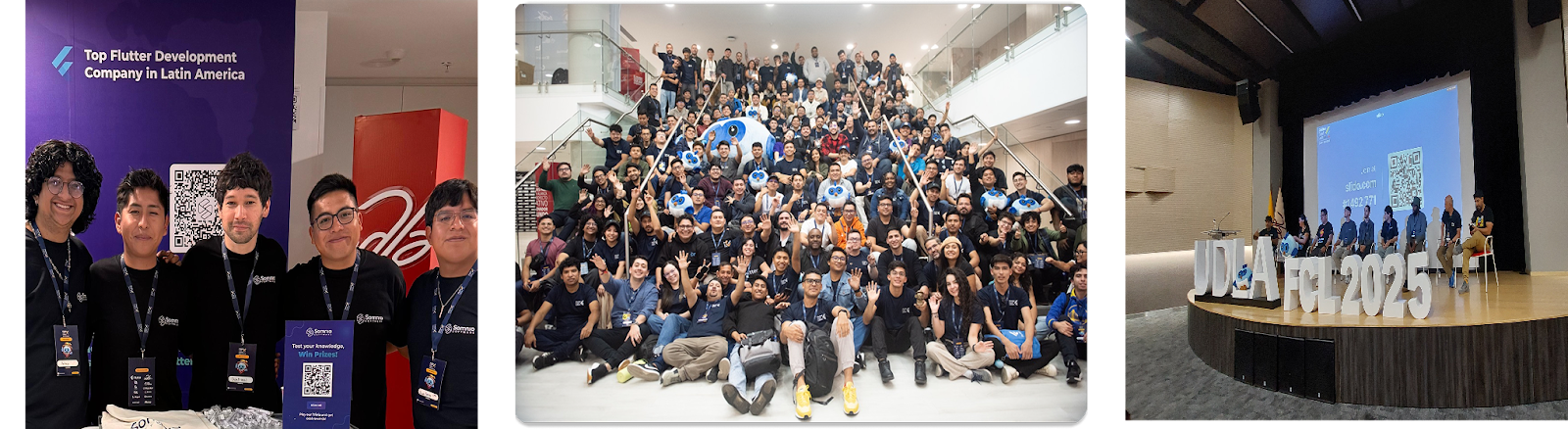
FlutterConf LATAM brought together developers from across Latin America, reinforcing Flutter’s strong presence in the region. The conference featured talks covering advanced Flutter topics as well as emerging themes around automation, code generation, and AI-assisted development.
Somnio Software participated as a sponsor and, with many speakers, contributing sessions focused on integrating AI into Flutter workflows and maintaining consistency between backend schemas and UI through code generation. Beyond formal talks, the event emphasized community exchange, with developers sharing real-world experiences migrating large apps and experimenting with new tooling.
FlutterCon Europe 2025 (Berlin)
FlutterCon Europe marked one of the largest Flutter gatherings to date. The agenda reflected a mature ecosystem, with sessions on rendering optimizations, Impeller, testing strategies, and multi-platform architecture. AI-related topics appeared in panels and live demos, including examples of using MCP-based tooling to assist with debugging and UI inspection.
The conference underscored how Flutter is increasingly used in regulated and large-scale environments such as finance and healthcare, where reliability and maintainability are critical.
Google I/O 2025: Flutter in Production
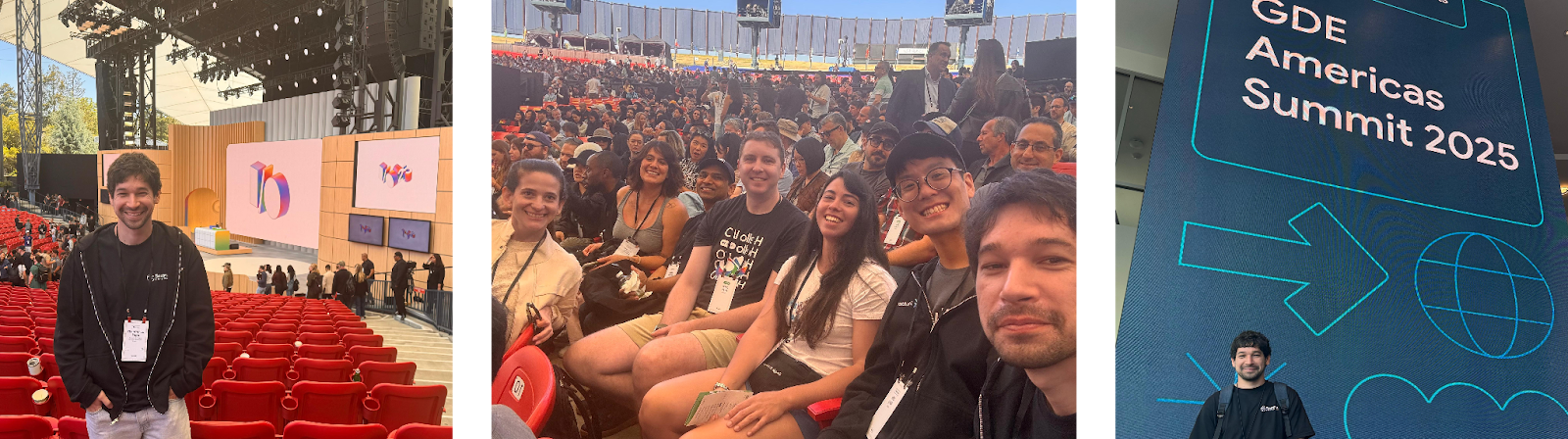
At Google I/O, Flutter featured prominently in real-world product stories. Google shared adoption data highlighting Flutter’s growing presence on iOS, alongside examples of Flutter powering AI-driven and high-scale applications.
Notable case studies included:
- NotebookLM, whose mobile app was built with Flutter to rapidly reach both Android and iOS users.
- teamLab, which uses Flutter for interactive museum experiences at large scale.
- Universal Parks, where Flutter is used not only in mobile apps but also in in-park kiosks, demonstrating code reuse across form factors.
- Additional examples in embedded devices and consumer applications, reinforcing Flutter’s flexibility beyond mobile.
Together, these examples illustrated Flutter’s role as a production-ready framework across diverse domains.
5. Wrapping Up: Lessons from 2025
Looking back, 2025 was less about a single breakthrough and more about convergence. Flutter continued to refine its foundations through architectural improvements and tooling investments, while AI tools became a practical part of everyday development work.
A few themes stand out:
- Flutter’s long-term direction is clear: modularity, performance, and adaptability across platforms.
- AI is becoming part of the development workflow, supporting planning, coding, testing, and UI generation rather than replacing engineers.
- Community matters: shared knowledge, open standards, and real-world experience helped teams navigate rapid change.
At Somnio Software, these shifts translated into experimentation, learning, and gradual integration of new tools into real projects. The focus remained on building reliable, user-centered products while selectively adopting new capabilities where they added clear value.
As we move into 2026, continued convergence between Flutter and AI tooling is likely. The challenge and opportunity, will be applying these tools thoughtfully, keeping user experience, maintainability, and engineering quality at the center.