.png)
Full product development services cover more than writing code across platforms. The decisions that determine how well a product scales: API contracts, state management strategy, CI/CD structure. Made badly, or made separately per platform, they compound into the kind of technical debt that turns a three-month backlog into a six-month one.
Why a separate codebase per platform backfires
Most multi-platform products don't fail because of bad code. They fail because mobile, web, and backend get built as three separate efforts, and each one makes slightly different versions of the same architecture decisions.
Without a shared source of truth for how the API is consumed, mobile and web end up modeling the same entities differently; one team's user object isn't the other's. By month four, the backend is patching around both versions instead of serving one contract.
This compounds fast. Separate codebases mean separate backlogs and separate QA cycles.
A feature that takes one sprint on mobile takes two on web, because the two sides interpreted the same requirement differently.
The budget doesn't double; it fragments into pieces that are hard to track and harder to reconcile:
- No shared API contract means mobile and web consume the backend differently, and the two versions of the same entity drift apart with no clear canonical source.
- Mobile and web models authenticate differently, producing two versions of the user model with no single point of ownership.
- Independent backlogs mean the same requirement gets interpreted differently per platform, stretching timelines without expanding scope.
- Hiring a specialist per platform reinforces this divergence instead of resolving it, since each hire optimizes for their own platform in isolation.
Choosing the right architecture for the product
Most products don't need a separate codebase per platform. A single core codebase, typically Flutter, can cover mobile, web, and desktop from day one. The cases where it's worth deviating are specific, and they're identifiable during discovery rather than guessed at mid-build.
Consumer apps across iOS, Android, and web
When the UI logic needs to stay consistent across platforms, one codebase compiling to all three targets is the default. The team maintains one set of widgets, one state management layer, and one test suite instead of three parallel implementations.
Products with platform-specific rendering needs
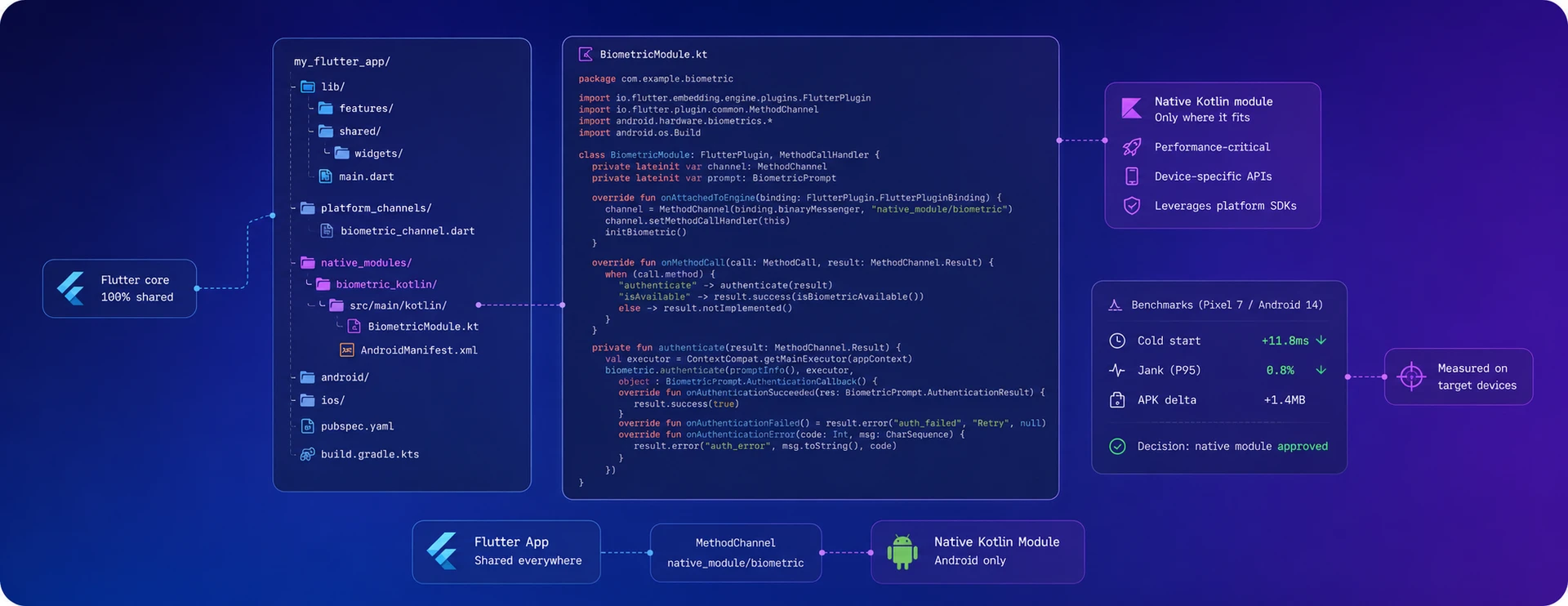
A fintech trading view with heavy platform-level rendering is a case where native Kotlin or Swift modules earn their place, layered alongside the core codebase for the specific screens that need that level of control, not as a replacement for the whole product.
Products where the web layer needs SEO
If indexability matters for the web surface, a Next.js layer with server-side rendering covers that need without pulling mobile into the same decision. The mobile and desktop targets keep shipping from the core codebase.
What each architecture gets you
A core codebase carries shared business logic, a single design system, and one CI/CD pipeline. One merge request triggers builds across targets, so if a test fails on web but passes on mobile, the divergence shows up immediately instead of surfacing weeks later.
Native modules, used selectively, get platform-level rendering control for the specific flows that need it without forcing the rest of the product into native development.
A Next.js layer gets indexability for the parts of the product that are actually discovered through search, without touching the mobile codebase at all.
The same logic applies to the backend and infrastructure. Defining API contracts once means both mobile and web consume the same endpoints without separate negotiation.
Choosing Firebase for real-time features or AWS for heavier compute happens once, based on the product's actual load instead of being retrofitted after the original choice stops scaling.
When each approach actually applies
- Default to a single core codebase unless a specific module needs rendering control the core stack can't replicate.
- Add native modules only for the screens or flows that require it, not the rest of the product.
- Add a separate web stack only when SEO or indexability is a real requirement, not as a default choice.
- Decide backend and infrastructure based on the data and scaling needs identified during product discovery, not on a fixed preference applied to every project.
Effect on launch timelines and engineering cost
Fewer separate efforts means less to reconcile. When one team owns the architecture end-to-end, there's no translation step between three implementations of the same decision, which is usually where timelines stretch the most.
A single CI/CD pipeline catches platform divergence immediately instead of weeks later, which keeps QA from becoming a per-platform bottleneck.
Because fixes ship from one codebase to every target in the same release cycle, post-launch maintenance means estimating once, building once, and testing once instead of repeating the same work across separate codebases.
The ProWallet case is a concrete example: a fintech product covering multiple surfaces without the overhead of parallel build tracks.
FAQ
Does building from one core codebase mean giving up native performance?
Not for the product as a whole. Native modules can be layered into a core codebase for the specific screens that need platform-level rendering control, while the rest of the product keeps shipping from the shared codebase.
If there's already a core codebase, when does a separate web stack make sense?
When SEO or indexability is an actual requirement for the web surface. Server-side rendering through a framework like Next.js solves that specifically, without changing how mobile and desktop are built.
How does a core codebase change maintenance over time?
A fix or new feature gets estimated once, built once, and tested once, then deployed across platforms in the same release cycle. With separate codebases per platform, the same work happens independently three times, often with three slightly different outcomes.
How does the architecture decision actually get made?
During discovery, based on the platforms' real technical requirements: rendering needs, SEO, scaling constraints, not as a fixed rule applied to every product regardless of what it actually needs.
At Somnio Software, we work closely with companies navigating exactly this kind of architecture decision, designing and building high-quality digital products where mobile, web, and backend stay consistent from discovery through launch.
If you're thinking through how to structure your stack or where your current codebase creates risk across platforms, we'd love to have that conversation. Contact us.